
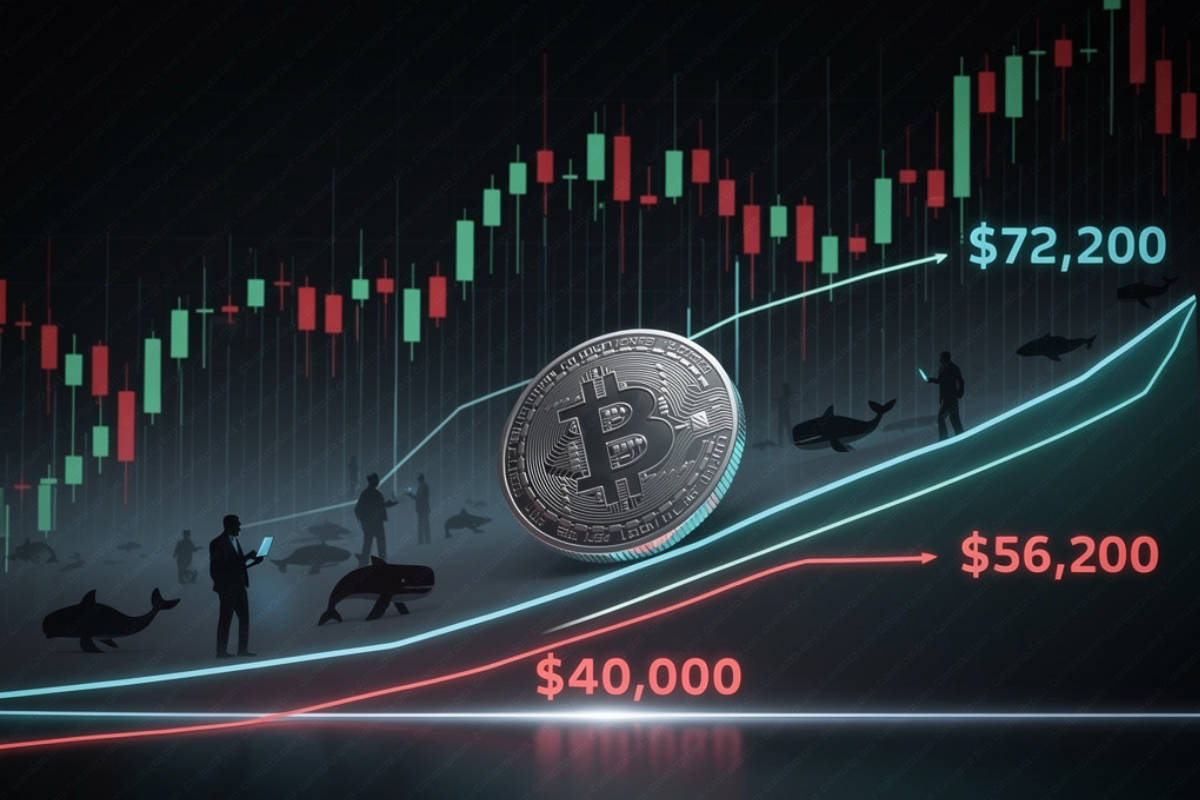
Realized Losses Dominate: Glassnode Data Suggests Bitcoin's Correction May Mirror 2018–2019 or 2022 Prolonged Bottoms
Bitcoin has declined to test critical support near $64,200, with intraday lows reaching $62,526 on Tuesday—a move that reflects mounting bearish pressure across on-chain, sentiment, and technical indicators. The asset now trades within a narrow consolidation range of approximately $62,200 to $73,000, a structure that has persisted for nearly three weeks as market participants assess whether the current correction represents a final capitulation phase or an extended bear market development.
Price Action and Sentiment Context: Extreme Fear Dominates
Bitcoin's recent price action underscores a risk-off environment driven by macroeconomic uncertainty and negative sentiment:
Metric | Current Reading | Historical Context | Interpretation |
|---|---|---|---|
Price (Intraday Low) | $62,526 | ~50% decline from $126,273 peak (Oct 2025) | Deep correction consistent with prior cycle drawdowns |
Daily Change | -3.26% | Elevated volatility during consolidation | Selling pressure remains active |
Fear & Greed Index | 11% ("Extreme Fear") | Levels <20 often coincide with local bottoms | Sentiment exhausted, but not yet a confirmed reversal signal |
Consolidation Range | $62,200–$73,000 | ~3-week duration | Directional bias pending breakout/breakdown confirmation |
The confluence of extreme fear, significant price decline, and prolonged sideways action creates a classic "decision zone" where the next decisive move could establish the medium-term trend.
On-Chain Warning: Realized Profit/Loss Ratio Below 1.0
A critical on-chain metric has turned decisively bearish: Glassnode's 90-day moving average of the realized profit/loss ratio has fallen below 1.0, indicating that Bitcoin is now changing hands at a net loss rather than a net gain.
Realized Profit/Loss Ratio Dynamics:
Threshold | Interpretation | Historical Precedent |
|---|---|---|
>1.0 | More BTC sold at profit than loss; bullish momentum | Bull markets, accumulation phases |
=1.0 | Neutral; profit-taking balanced by loss realization | Transition periods, consolidation |
<1.0 | More BTC sold at loss than profit; bearish pressure | Bear markets, capitulation phases |
Current Reading: <1.0, approaching critically low levels
Historical Parallels:
2018–2019: Realized P/L <1.0 persisted for ~6+ months before sustained recovery
2022: Extended period below 1.0 coincided with prolonged consolidation near $16K–$20K
This metric suggests that widespread loss realization is underway—a pattern that often precedes either:
Capitulation and Bottom Formation: When loss-taking exhausts selling pressure, creating conditions for reversal
Extended Bear Market: When loss realization continues without sufficient new demand to absorb supply
Whale Behavior: Average Buy Price at $53,400 and Sub-$40,000 Risk
Data from Whale Alert indicates that the network-wide average acquisition cost for large holders is approximately $53,400. Frank S., founder of Whale Alert, noted that historical patterns suggest Bitcoin could decline below $40,000 before a sustainable recovery emerges—though he expressed hope that this cycle might avoid repeating past bear market depths.
Whale Buy Price Context:
Metric | Value | Implication |
|---|---|---|
Whale Average Buy Price | ~$53,400 | Key support zone if price declines further |
Potential Downside Target | <$40,000 | Tail-risk scenario based on historical cycle patterns |
Current Price vs. Whale Cost | ~$64,200 vs. $53,400 | ~20% above average whale entry; room for further correction |
While whale accumulation can provide pockets of support, the current regime—characterized by dominant loss-taking and weak marginal demand—resembles past prolonged bear markets where price discovery required extended time and deeper drawdowns.
Technical Structure: Falling Channel and Range-Bound Action
From a charting perspective, Bitcoin has been trading within a descending channel pattern since October 6, 2025, with price action constrained by two parallel trendlines:
Technical Element | Level | Significance |
|---|---|---|
Upper Channel Boundary | ~$73,000 | Resistance; breakout required for constructive bias |
Lower Channel Boundary | ~$62,200 | Critical support; breakdown invites deeper correction |
Intermediate Resistance | ~$67,000–$69,000 | Supply zone where prior rallies stalled |
Next Major Support | ~$56,000–$58,000 | Realized price and 200-week SMA confluence |
Tail-Risk Support | ~$40,000 | Historical cycle low reference; extreme scenario |
Key Technical Observations:
A long-tail rejection candle at $62,200 suggests demand emerged at this level, providing tentative support.
However, the broader falling channel structure remains intact; a sustained close below $62,200 would confirm bearish continuation.
A decisive reclaim of $73,000 with volume expansion would invalidate the near-term bearish structure.
Forward Scenarios: Defining Risk and Opportunity
For investors evaluating Bitcoin's trajectory through the coming weeks, two conditional frameworks merit consideration:
Bearish Continuation Scenario:
Failure to hold $62,200 with expanding volume; lower lows extend toward $56,000–$58,000
Realized P/L ratio remains <1.0; loss realization persists without absorption
Fear & Greed Index stays in "Extreme Fear" (<15) without reversal confirmation
Potential downside targets: $56,000–$58,000 (structural support), then $40,000 (tail-risk scenario)
Constructive Reversal Scenario:
Successful defense of $62,200 with diminishing selling pressure; higher lows establish
Realized P/L ratio stabilizes or rises toward 1.0; loss-taking exhausts
Fear & Greed Index begins mean-reversion from extreme lows
Potential upside targets: Reclaim of $67,000–$69,000 resistance, then retest of $73,000 range ceiling
Analytical Balance: Historical Precedent vs. Cycle Evolution
Prudent analysis requires contextualizing current signals within both historical patterns and structural changes:
Constructive Signal | Risk Consideration |
|---|---|
Extreme fear (Fear & Greed 11%) often coincides with local bottoms | Sentiment can remain extreme for extended periods during bear markets |
Whale average buy price at $53,400 provides potential support zone | Further declines toward $40,000 remain plausible if macro deteriorates |
Long-tail rejection at $62,200 shows demand at key support | Falling channel structure remains bearish until broken |
Historical precedent: Bitcoin recovers from deeper corrections | Current realized P/L <1.0 suggests correction may extend before reversal |
Institutional infrastructure (ETFs, custody) more mature than prior cycles | Macro headwinds (real yields, dollar strength) may dominate crypto-specific factors |
Key Variables to Monitor
Indicator | Bullish Confirmation | Bearish Continuation |
|---|---|---|
Realized P/L Ratio | Stabilizes or rises toward 1.0; loss-taking moderates | Remains <1.0; continued net loss realization |
Technical Structure | Sustained close above $67,000 with volume; higher lows form | Breakdown below $62,200; lower lows extend toward $56K |
Sentiment Metrics | Fear & Greed Index mean-reverts above 20; extreme fear abates | Index remains <15; capitulation sentiment persists |
Whale/Institutional Flows | Accumulation accelerates; exchange outflows expand | Distribution continues; exchange deposits rise |
Macro Liquidity | Real yields drift lower; dollar stabilizes or weakens | Tightening financial conditions; risk-off sentiment dominates |
Conclusion: Patience Amid Structural Uncertainty
Bitcoin's current posture—testing $62,200 support with realized profit/loss ratios below 1.0, extreme fear sentiment, and a falling channel technical structure—reflects a market in a critical decision phase. Historical precedent suggests that such conditions can precede either capitulation-driven bottoms or extended bear market consolidation.
For investors, the prudent approach may involve:
Defining clear invalidation levels for any directional position (e.g., sustained break below $62,200)
Monitoring confirmation signals: realized P/L stabilization, volume expansion on upside attempts, sentiment mean-reversion
Recognizing that bottom formation is typically a process, not a single event; exhaustion, not excitement, often marks the turn
In volatile, adaptive markets, preparation and multi-factor analysis often prove more valuable than conviction in any single narrative—whether bullish or bearish.
Disclaimer: This report is for informational purposes only and does not constitute financial, legal, or investment advice. Cryptocurrency markets are highly volatile and subject to rapid change; readers should conduct independent research, verify on-chain data through primary sources such as Glassnode, Whale Alert, and blockchain explorers, monitor sentiment metrics via official Fear & Greed Index publications, and consult qualified professionals before making allocation decisions. On-chain metrics and technical patterns are descriptive, not predictive; past relationships do not guarantee future behavior. Digital asset investments involve substantial risk of loss, including potential total loss of principal.